Friday, April 20, 2007

Renaissance music and composers

A rebirth of Classical learning
The rediscovery and reevaluation of writings of the ancient Greeks and Romans suggested a "rebirth". Nineteenth-century historians seized on the idea to create our present image of "The Renaissance".

The gradual change from the feudal system to the modern state
Starting in northern Italy, the hierarchical state -- led by either the urban bourgeoisie or despotic nobles -- replaced the fluid and often chaotic feudal system of the Middle Ages. For this reason, some historians refer to the Renaissance as the Early Modern Era.

A change in the views of the earth and the cosmos
Christopher Columbus (1451?-1506) and Ferdinand Magellan (c.1480-1521) expanded Europe's view of the world. The astronomical studies of Nicolaus Copernicus (1473-1543) -- later championed by Galileo Galilei (1564-1642) -- called into question the old earth-centered view of the universe.
MUSICAL CONTEXT

Increased Interest in Humanist Learning

* The arts became an important measure of learning and culture.
* Music moved from the science of number to an expressive art viewed as an equal to rhetoric.
* The rise and rapid spread of music printing increased access to music and books about music.

Increased Patronage of Music

* The rich courts and civic governments of the Renaissance supported music to a degree not previously seen.
* This level of musical support was also provided by the religious institutions of the day.

Territorial Expansion and Increased Wealth

* As a result of colonial expansion, great wealth flowed into European cities and courts.
* Travel and the resulting musical exchange became a driving force for the creation of a more international musical style.
* MUSICAL STYLE

The composers of the Renaissance concerned themselves with three different areas of music:
All three types of music share many musical features:

> Guillaume Du Fay (1397-1474)
> Josquin Desprez (c.1440-1521)
> Giovanni Pierluigi da Palestrina (c.1525-1594)
> John Farmer (fl.1591-1601)
> Claudio Monteverdi (1567-1643)

Sunday, April 15, 2007

Descartes, Bacon and Newton, giant's of science


Rene Descartes wrote his Discourse on Method 50 years before Issac Newton published his Principia. The Principia stunned the world and quickly established Newton as the leading intellectual of his age. Everyone recognized it as epoch making. But the Principia and the ideas it contained were built against a backdrop of feverish excitement that began well over a century before with Copernicus who had literally torn the cosmos from its foundations and hurled it into space. Aristotle's universe, Ptolemy's universe, had been overthrown. It took some time to sink in. But when it did, there began a concerted and feverish process of rebuilding the world on a newfooting. The century and a half of reconstruction culminating in Newton's magnificent achievement."The book of nature, Newton's nature was seen in poetic termsas a divine romance -- a book written in disconnectedcorpuscular characters scattered throughout an infinite and empty void following the syntax of motion and the rule of attraction."
This Newtonian cosmos was radically different from Aristotle's.Aristotle's cosmos had been closed, finite,
and differentiated. This universe was open, infinite, and undifferentiated. It was mathematical, knowable, material and
predictable. It ran like a clock with such incredible precision that witnessed for most evidence enough of a divine clockmaker who took an active and omnipresent interest in the affairs of men. Newton did not require God as a first principle in his grand synthesis--but the product of his endeavors was evidence enough that God was. The optimism that this awareness inspired fueled the spirit of Newton's Age, the Age of enlightenment.But Newton's achievements, catalyzed in the first instance by Copernicus, were produced through his fusing and synthesis of many others who took on the challenge of rebuilding the cosmos. These must have been exciting and nervous times. Tradition and authority were dead--but what would take their place? There were many actors in the drama that culminated in Newton's triumph, but three men in particular stood out: Galileo, Francis Bacon, and Rene Descartes: Italian, English and French. Before looking at the distinctions amongst these three it is important to recognize, that in the grand scheme of the age in which they worked, and that although their strategies differed,they had much in common. They would have made a grand teaching team. All three were optimistic. All three were individualistic and egalitarian. All three were anti-traditionalist and actively about the business of getting on with the business of forging a new cosmos. All three held views that ignorance came from error. The synthesis that Newton produced could be represented as a line drawn from Galileo to Newton with Descartes and Bacon standing on either side. Bacon is the proponent of a method of empiricism, induction, experiment and observation--a gatherer of particulars. Descartes is seen as the champion of deduction, the rational thinker. Newton, is seen as the harmonizer of these two contrasting approaches, claiming, correctly, that induction and particulars are primary, but, in fact, relying heavily on a system of grand intellectual constructions--space and time especially - which are very much from the tradition of Descartes. Notice that while the "language of Newton" is very much Baconian in tone and intent: RULE IV In experimental philosophy we are to look upon propositions inferred by general induction from phenomena as accurately or very nearly true, notwithstanding any contrary hypotheses that may be imagined, till such time as other phenomena occur by which they may be made more accurate or liable to exception. (Rules of reasoning). ...that it was Descartes who had the greatest influence on Newton's method through his "Analytic Geometry," which was Descartes' crowning intellectual achievement.

Wednesday, April 11, 2007

Renaissance Thinking


In Spain, as in other European countries, sixteenth-century painting is characterized by eclecticism, or rather by the synthesis of a number of different trends: national tendencies, the influence of the great Italian masters, and certain elements of the art of Northern and Central Europe. In the early years of the century, the formula was thoroughly Quattrocento, but the use of oils and a growing interest in naturalistic representation and the manipulation of space nullified or progressively diluted the surviving Gothic characteristics. With the passage of time gold backgrounds became increasingly rare, and landscapes gained in breadth and luminosity. Many Spanish artists visited Italy, attracted by the fame of the Italian schools. While there, some underwent a technical and aesthetic transformation, and, on returning to Spain, contributed decisively to the growth of the Renaissance spirit, spreading their version of the great lessons to be learned from the art of Leonardo, Raphael, and Michelangelo. These influences remained dominant until the middle of the century, though, as we have mentioned, not without interference from Flanders, Germany, and Holland.

The most important characteristic distinguishing the Renaissance painting of Spain from that of Italy, France, and Germany relates more to subject matter than to style. It is the Spanish rejection of mythological themes and the cult of the nude. The Spanish artist of the sixteenth century·shared the spirituality of hís Gothic forebears; in general, he worked for the churches and monasteries, or for nobles with similar religious preoccupations. Many of the better paintings of this period are imbued with the mysticism of the ascetic, and are remote not only from thc sensualism associated with paganistic themes, but also from the cult of art for art's sake and sheer aestheticism. The foreigners who came to work in Spain during this period, which, it must be remembered, coincided with the peak of Spanish imperial power, were quickly assimilated. Far from resisting the established tradition in Spain, they sometimes became among its most passionate interpreters.

Challenge: The weight of history. Leonardo da Vinci first designed a bridge to cross the Bosporus strait at Istanbul in 1502, but the sultan to whom he presented the project didn't believe that the bifurcated, tapered stone arch span could be built.

Solution: Vebjørn Sand, a Norwegian artist, came across the bare-bones design at an exhibition of da Vinci's engineering work and persuaded Norwegian transportation officials to give it a shot. But stone is out; 500 years later, glu-lam - glue-laminated wood - brings the concept to life.

The influence of Leonardo

Spanish painting was given a new and more determined thrust in the direction of the Renaissance by two artists trained in Italy: Fernando Yáñez de la Almedina and Fernando Llanos. In 1507 they were jointly commissioned to paint the great retable still in Valencia cathedral. The styles of both masters are distinguished by clarity of composition, a taste for static poses and attitudes, and an appreciation of architecture, less for the sake of the prolific ornamental detail, of which other painters of the period were so fond, than for the balance of masses. In the scenes of this retable, taken from the life of the Virgin, their debt to Leonardo is very obvious. Although the styles of the two painters have much in common, Yáñez's manner is distinguished by the greater monumentality of his figures. Llanos appears to be more addicted to the emotional gesture and the troubled expression. After 1513, the two artists worked independently, Yáñez producing the notable St Catherine in the Prado, the Epiphany and Pieta of Cuenca cathedral, painted in 1531, and the Last Judgment in the March collection in Mallorca. Together, Yáñez and Llanos exerted a widespread influence on the schools of Murcia and Valencia.

Unlike fifteenth-century art, Catalan painting of this period, that is, of the first quarter of the sixteenth century, did not revolve about a group of exceptional personalities. Individual masters, mostly foreigners, produced work of some interest in different centers throughout the province, particularly in Gerona, Tarragona, and Barcelona. The most eminent of these artists was Ayne Bru, a painter of German origin, to whom we owe the magnificent Martyrdom of St. Cucufate, preserved in the Museum of Catalan Art. This painting is remarkable for the sensuous opulence of the modeling, which is rich in tactile qualities and suggestive of the style of Leonardo. Gerona was the home of a very gifted painter known as Juan de Borgoña (of Burgundy). His work also appears in Valencia, and his art, with its wealth of forms and colours, was known along the entire Mediterranean coast of Spain.

Eclecticism

About the year 1500 a number of talented painters were at work in the principal cities of southern and central Spain. Their art is often eclectic, comprising both Northern and Italian elements, with the balance weighted somewhat in favor of the latter. In Toledo, the first third of the sixteenth century is dominated by the personality of Juan de Borgoña. In 1495 he worked in Toledo cathedral, together with Pedro Berruguete. His painting is remarkable for its exquisite sensitivity, its balance, and a warm lyricism intolerant of all excess. There is evidence of early exposure to Florentine influences, together with hints of the Gothic, especially strong in the fall of the draperies. Luminous colours and the subtle organization of space are the distinguishing features of Juan de Borgoña's magnificent decorations in the chapter house of Toledo cathedral (1509-11), in which the landscape plays such an important part. In addition to executing several retables in Toledo, the artist also completed the retable of the Cathedral of Avila, begun by Pedro Berruguete, which includes an exquisite Annunciation. In his studio work, which is rather voluminous, some of the more valuable qualities of the master tend to be neutralized. During this same period some outstanding paintings were being produced in Seville by Alejo Fernández. In 1496 he is reported in Cordova, but soon afterward he moved to Seville, where he continued to live until his death in 1545. Strong in composition, Fernández was particularly skillful in handling his figures, which are distributed with imagination and judgment and modeled with unusual grace, as may be seen in his Epiphany in Seville cathedral. The cities of Sevilla and Saragossa possess important examples of his work, in particular the Virgin of the Navigators from the Alcázar of Seville, in which the sober and balanced composition and the nobility of form foreshadow Zurbarán.

During the second third of the sixteenth century, a number of Spanish painters fell heavily under the influence of Raphael. Typical in this respect, in Valencia, are the members of the Masip family: Vicente Masip and his son, Juan de Juanes. The work of the latter, mostly later than 1550, is distinguished by a certain formalistic elaboration of the directions taken by his father, and is by no means lacking in grace or skill. Juan de Juanes was the creator of a group of models of Spanish piety. His work is harmonious, rhythmically transparent, and well designed. These characteristics are particularly evident in his more popular compositions, such as the Holy Family in the Academy of San Fernando, the Redeemer in the Valencia Museum, and the Last Supper in the Prado Museum. His father's most important achievement is the retable in Segorbe cathedral, painted about 1530.

In Seville, the second third of the sixteenth century also witnessed the introduction of a style of painting that reflected the ascendancy of Raphael. In this center, the most important artist of the period were undoubtedly of Northern origin: the Dutchman Fernando Esturmio (Storm), and the Fleming Pedro de Campaña (Kempener). The latter, the more gifted of the two, was born in Brussels in 1503. He was trained in Italy, but in 1537 he is known to have been employed in the Cathedral of Seville. Shortly before 1563 he returned to his native country. The style of this master includes elements derived from Michelangelo, but these are offset by original plastic qualities and a sense of drama. One of Campaña's key works is the Descent from the Cross (1547) in Seville cathedral, a painting that anticipates the Baroque of Rubens and was much admired by other Spanish artists, particularly Murillo. Campaña had a more amiable and genuinely Raphaelesque side, evident in the altarpiece of the Marshal's Chapel in Seville cathedral, which he was commissioned to paint in 1555. His progress toward the Baroque and his interest in the rendering of light are revealed in his admirable Adoration of the Magi, which was painted in 1557 (church of Santa Ana, Seville).

There is no space to mention all the numerous artists working in Spain at this time, but we must refer, however briefly, to the paintings of that sculptor of genius, Alonso Berruguete, in particular to his Nativity in the Valladolid Museum, and to the work of Pedro Machuca, an extraordinary architect.

Luis de Morales (called El Divino), born in 1510, was a distinctly original personality. The distinctive features of his style - a painstaking technique inherited from the Flemish masters, and elongated forms that foreshadow the art of El Greco - are especially evident in the works of his final period. Morales painted numerous versions of the Virgin and Child, sometimes with the infant St.John, and touching visions inspired by the theme Ecce Homo, which are among his most popular works. Sensitivity to content and concentration on the sacred drama are the chief characteristics of this typical representative of Spanish asceticism.

The third quarter of the sixteenth century brought a strong desire for innovation. This coincided with the infiltration of Mannerism, openly introduced by the Italian painters who decorated the Escorial, and a renewed interest in the Venetians, particularly in their colours. The painter who best represents these tendencies is Juan Fernández Navarrete, called "the Mute" because of the affliction from which he had suffered since boyhood. After a "short" stay in Italy, where he had contact with Titian's studio, he started work in the Escorial in about 1568. Thanks to the forcefulness of the image, his realistic and merciless version of the Martyrdom of St. James (1571) is one of his best known works, but his Adoration of the Magi (1575), also in the Escorial, better reveals his painterly preoccupation with light, chiaroscuro, and colour. Navarrete died in Toledo in 1579.

Portrait Painting

The art of the second half of the sixteenth century was by no means exclusively religious. Portrait painting also flourished. The Dutch portraitist Anthonis Mor (1519?-1576) was followed by his pupil Alonso Sánchez Coello (1531/32-1588), who gave a decided impetus to this genre with work of the caliber of his portraits of Philip II and the royal children Don Carlos and Isabella Clara Eugenia (Prado Museum). This artist has rightly been praised for his humanity, which, in its intimate relationship to plastic values, makes him the direct precursor of Velázquez portraits. The preoccupation with tactile qualities and the convincing representation of materials, characteristic of Sánchez Coello, is even more noticeable in the work of his pupil and successor, Juan Pantoja de la Cruz (1551-1609). In his somewhat hieratic portraits, the character of the subject is of less interest than the verisimilitude of jewels, lace, silks, brocades, and nielloed armor. Pantoja, like Sánchez Coello, painted religious subjects as well as portraits, and in this genre he worked with greater freedom, achieving a more truly pictorial effect. He was also absorbed in the problems of dark and light, as revealed in his Resurrection (1605), now in the Hospital of Valladolid.

The last quarter of the sixteenth century produced a variety of painters who, for all their interest, are typical transitional figures, associated with a period of fluidity that was soon to crystallize in a new conception of painting. Prominent among these artists were Pablo de Céspedes in Cordova, and, in Seville, Vasco de Pereira and Francisco Pacheco, the teacher and father-in-law of Velázquez, who in his latter years (1649) published an interesting treatise, Art of Painting.

El Greco's Painting

The great revolution that burst on the mediocrity of late sixteenth-century Spanish painting turned largely upon the genius of El Greco, Italian-trained under Venetian masters, yet a supreme individualist and the possessor of a technique as advanced and effective as any in Europe. There is something miraculous about the outcome of a career so full of internal contradictions and exposed to so many apparently conflicting influences. Born on the island of Crete in 1541, Domenicos Theotokopoulos must have begun to paint in the Byzantine icon tradition, which is discernible in much of his later work. Later, under the spell of Venice, he determined upon a very different course. In 1570 Giulio Clovio noted an encounter in Rome with "a young native of Candia, a pupil of Titian, who in my judgment seems to have a rare gift for painting." In fact, El Greco did develop his singular talents under Titian and Tintoretto and produced work of astonishing power even during these youthful years in Italy. Venetian influence is apparent in the Portrait of a Man (National Gallery, Copenhagen), in the Healing of the Blind Man in the Dresden Pinakothek, and in other paintings. In Rome, in spite of his diatribes against him, El Greco learned much from Michelangelo, acknowledging, in particular, the grandeur of his conception of the human body, stressed by tensions that reveal a supernatural world.

News of the building of the Escorial, and the example of the Italian painters who went to Spain to work on its decoration, may have influenced El Greco's decision to seek new goals. His mysticism must have enabled him to identify himself with the Spanish ideals of the Golden Century more completely than with the sensuousness and literary themes of Italian art. In 1577 he was engaged in painting the great retable of Santo Domingo el Antiguo in Toledo, dominated by two great panels, The Trinity and The Assumption, now in museums in Madrid and Chicago. The El Greco of this period is still very restrained, concerned with closed forms, and able to invest his sacred themes with a sense of monumentality, while finding a means of self expression in the tumultuous life of his colours.

El Greco's work is distinguished by a marked interest in human types, to which his success as a portrait painter must certainly be attributed. At the same time, this success is founded less on objectivity than on a talent for selecting models sympathetic to a conception of the world exalted by religious feeling. The culmination of his art is to be found in the paintings based on the Gospels and other sacred themes, such as the famous Espolio, painted in 1577-1579 (sacristy of Toledo cathedral). El Greco used the folds of robes and draperies to establish a rhythmical movement suggestive of the medieval style, but handled with the freedom of the Baroque. The reflections and textures of the fabrics are rendered with marvelous skill. In 1580-1582 he painted his striking version of the Martyrdom of St Maurice (Escorial), a carefully studied composition with an original colour scale of cold blues, yellows, greens, and violets. This work, commissioned by Philip II, failed to please the monarch and was refused.

Thereafter El Greco turned from a course that, if pursued, would have brought him greater wealth and honours. In 1586-1588 he executed one of his masterpieces, preserved in the church of Santo Tomé in Toledo, for which it was painted. This is the Burial of Count of Orgaz, a magnificent composition, based on a fourteenth-century legend, in which the artist expresses his disdain for externals and his interest in the "interior light" and the human form. In this picture the figures of knights and monks form a frieze beneath which two saints support the body of the count. The splendors of the heavenly realm are blazoned across the distant sky. The ascent to Heaven was a favorite subject of El Greco, a theme reiterated in his rhythms, chiaroscuro, and colour. In these paintings the mystical element is counterbalanced by a profoundly human interest in the earthly model. In this connection it is enough to note the portrait of Cardinal Fernando Nino de Guevara in the Metropolitan Museum of Art, New York, and the impressive St Ildefonso preserved in Washington.

El Greco was interested in landscape less for the sake of its anecdotal value and natural beauty than for its spiritual qualities and the atmosphere. This is the mood of his masterly View of Toledo (1597 to 1599), also in the Metropolitan Museum. The artist also had to satisfy a steady demand for pictures of the saints. He was therefore obliged to resort to the expedient of painting them in series, sometimes with the aid of assistants. In this way he produced numerous versions, closely similar or with certain variations, of his conception of St Francis of Assisi, the repentant St Peter, St Jerome, Mary Magdalene, and so on. In his maturity he allowed freer rein to a personal tendency to distort and elongate his figures, as in the Resurrection in the Prado (1607) and in the Opening of the Fifth Seal in the Metropolitan Museum. During his final period, this tendency was exaggerated and combined with a process of simplification and elimination of detail and a frequcnt indulgence in contortion. These qualities he brilliantly combined with the most sumptuous palette, as may be seen in the Laocoön in the National Gallery of Art, Washington D.C.

It seems probable that the artist accepted the assistance of collaborators in some of the series he painted in the final years of his life, but it is no less certain that he preserved until the very end that absolute mastery over his art so conspicuous in the superb Twelve Apostles in the Casa del Greco. Francisco Preboste and the painter's son, Jorge Manuel, were probably his principal collaborators, while Luis Tristán was the best of his pupils.

Monday, April 9, 2007

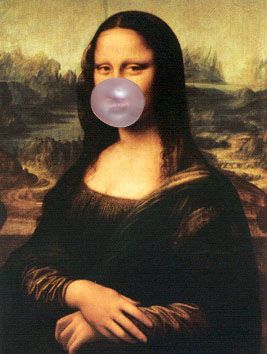
mona lisa stolen


Most of pictures from this blog are taken from nice studio site .On Monday, August 21, 1911, the world's most famous work of art--Leonardo da Vinci's Mona Lisa--was stolen from the Louvre museum in Paris. That morning, many museum employees noticed that the painting was not hanging in its usual place. But, they assumed the painting was taken off the wall by the official museum photographer who was shooting pictures of it up in his studio.
By Tuesday morning, when the painting hadn't been returned and it was not in the photographer's studio, museum officials were notified. The painting was gone!
The police were contacted immediately and they set up headquarters in the museum curator's office. The entire museum was searched from top to bottom. This took a week because of the size of the Lourve: it's a 49-acre building which runs along the Seine river for 2,200 feet. The only thing a detective found was the heavy frame that once held the Mona Lisa. It was discovered in a staircase leading to a cloakroom.
Once the news became public, French newspapers made several claims as to the nature of the theft. One newspaper proclaimed that an American collector stole the work and would have an exact copy made which would be returned to the museum. This "collector" would then keep the original. Another newspaper said that the entire incident was a hoax to show how easy it was to steal from the Louvre.
Many people were questioned about the theft--from museum employees to people who worked or lived nearby. Perhaps somebody might have seen someone acting "suspiciously?" The police even questioned Pablo Picasso. Picasso had previously bought two stone sculptures from a friend named Pieret. Pieret had actually stolen these pieces from the Louvre months before the Mona Lisa was stolen. Picasso thought that perhaps his friend might have also stolen the Mona Lisa.
Fearful of the implications and bad publicity, Picasso had the sculptures given to a local newspaper in order for their return to the museum. Picasso wished to remain anonymous, but someone gave his name to the police. After an interrogation, the police concluded that Picasso knew nothing about the theft of the Mona Lisa.
Luckily, the painting was recovered 27 months after it was stolen. An Italian man named Vincenzo Perugia tried to sell the work to the Uffizi Gallery in Florence, Italy for $100,000. Perugia claimed he stole the work out of patriotism. He didn't think such a work by a famous Italian should be kept in France. What Perugia didn't realize was that while the Mona Lisa was probably painted in Italy, Leonardo took it with him to France and sold it to King Francis I for 4,000 gold coins.
How did Perugia steal the Mona Lisa? He had spent Sunday night in the Louvre, hiding in an obscure little room. Monday morning, while the museum was closed, he entered the room where the painting was kept and unhooked from the wall. In a staircase, he cut the painting from it's frame. While trying to leave the building, he came to a looked door. He unscrewed the doorknob and put it in his pocket. He then walked out of the Louvre and into the pages of history.
Interestingly enough, ten months before the painting was stolen, the Louvre decided to have all masterpieces put under glass. Perugia was one of four men assigned to the job. Police questioned Perugia after the theft, but his easy-going, calm demeanor settled any doubts of his involvement.
The source of this story on the Mona Lisa theft is The Art Stealers by Milton Esterow, New York: Macmillan Company, 1966. pp 100-152.

Copy of the Mona Lisa


"In 1983, a Japanese artist made a copy of the Mona Lisa completely out of toast." This curious fact and many more like it may be found on the "Fun Facts" World-Wide-Web page put out by the Northville Michigan Arts Commission (http://tln.lib.mi.us/~nort/yourpge4.html LINK DEAD 4/02), characterized on their web page as "a highly dedicated group of volunteers chartered to encourage, develop, and promote activities in all of the Arts." This identical piece of trivia is quoted word for word in no less than fifty other locations on the World Wide Web, where it is classified under a variety of demeaning and deprecating titles and rubrics such as "Amusing irrelevant facts," or "Useless (and unsubstantiated) facts," or "Totally useless facts." The list, in each of its iterations, is repeated item by item, with little variation, so that not infrequently, this seeming factoid about a toasted Mona Lisa directly follows the one about the child Albert Einstein who could not speak, or the one about the fellow who found a tooth growing out of his toe.

[Note: What may be the largest of these lists may be the one at the following URL: http://edisto.awod.com/gallery/rwav/wadem/dunno.html LINK DEAD 11/04. Here, the "facts" are presented "To help you through this absurd, twisted and some times silly world." In addition to the report of the Mona Lisa made of Toast, this list includes a notice reporting that Leonardo spent twelve years painting Mona Lisa's smile. This "fact" is repeated no less than 18 times on the Internet as of October 1998 under such titles at "Useless Trivia," or "Stuff No One Should Really Know. The following links to related trivia lists were supplied 10/04 by Carol Selkin:
Reports and illustrations of strange occurrences, prodigious events, wonders and other shocking truths have a long history in Western culture -- dating back (if we ignore Homeric and other ancient legends), certainly to medieval travel-books and tall tales about far-away places and the people who inhabit them. Fixed in place among so many bizarre rumors and curiosities, the report of a toasted Mona may seem to be just another one of those pseudo-facts (or factoids) to be read indiscriminately as "strange, but true," or "strange and not true" -- as you prefer. One thing is certain, however; in the lists of oddities, the story of a Mona Lisa in toast is robbed of context and offered to the public as something thoroughly meaningless and useless, an example of the worthless excesses of man in general and of modern artists in particular. Damned by association, vilified to insignificance, cited without the name of a maker, there is no way in such a context of contempt and derision to rescue the work (should it exist) and to demonstrate any meaning, substance or significance it may or may not have.

The work, in fact, is real, and is the product of artist Tadahiko Ogawa of Kyoto. The Mona as Toast does not always bend to the forces of ridicule, however. In an on-line edition of the Japan Times dated 1997, it is reported that a "Mona Lisa" whose image is burnt into slices of toast is Tadahiko Ogawa. Mona as Toast, ca. 1984displayed in an exhibit on "food as art" that was put up by the Tempozan Contemporary Museum. The above notwithstanding, it is not surprising, therefore that the permanent home of this work is the Orlando Florida exhibition hall of Ripley's "Believe it or not!" -- a collection of museums not known for their dedication to making sense of the world, but famous for showing its non-sense. Indeed, on the web-page of the Orlando Museum, the Mona as toast is cited as one example of work done by people "with too much time on their hands." What is the difference, we may ask, in accepting such an object as a serious or valid work of art and exposing it as a "useless" curiosity? Depending upon one's point of view, this is either a product of wasted time or one of certain ingenuity and verifiable industry. One thing is certain, this kind of criticism reveals more about the author than it does about the maker of the object. In this age when it is so easy to admit that cuisine can be aesthetic and hard to comprehend how art can be eaten, nobody seems to have noticed that the "Mona as Toast" looks surprisingly like a typical Leonardo brown ink drawing, squared off for transfer.

[Note: Japan Times: http://www.japantimes.co.jp/list/museums/1997/museumk6.html (Exhibit: "Delicious Art.")] LINK DEAD 4/02

[Note: From the Ripley's Orlando web page: "Then, there are exhibits which seem to scream 'some people have way too much time on their hands!' - a 1907 Rolls Royce Silver Ghost car made to two-thirds scale from more than a million match sticks, a family portrait made from dryer lint and the Mona Lisa from inch-square pieces of white toast, to name a few." (http://www.iloveorlando.com/ilo_ripleys.htm LINK DEAD 4/02). A telephone call to the Orlando museum provided the name of the artist, the date of acquisition (1984), and the fact that it was made of 1426 slices (or pieces?) of toasted white bread. But note Walter Benjamin's apt rejoinder to this materialistic assumption: "the fruits of idleness are more precious than the fruits of labor," (as quoted in Michael Kimmerman, "Museums in a Quandary: Where Are the Ideals?" The New York Times, August 26, 2001.)]

The "lists" do not tell us that Toast is in Orlando. It could easily be viewed as a fabrication of urban legend. It may be seen, illustrated, in an article from an unidentified magazine, where we are told that it is composed of 1,426 slices, and where, in the tradition of the lists, it is likened to other bizarre curiosities from the Orlando Ripley's: to a portrait of a Chinese emperor made from a laundry shirt and a reproduction of a Van Gogh self-portrait made from 3,000 postcards of the artist's paintings (also in Orlando). The caption begins: "From the ridiculous..." and only gets "to the sublime" when it mentions the Van Gogh. It is difficult to imagine why a Van Gogh made of 3,000 postcards is more sublime than a Mona Lisa made of 1500 slices of toast. Ostensibly, in the hierarchy of applied values at work here, postcards carry more weight than toast, or 3000 is more divine than 1500. These are not aesthetic criteria, of course, these works are being judged materialistically.

Is this the finale of one of the Western world's most revered works of art: to be ridiculed, commercialized, trivialized, and made ripe for any sort of exploitation? Do these stories indicate how far reverence for Leonardo's masterpiece has fallen since the 19th century, when it came to stand as a hallmark and embodiment of Renaissance beauty and accomplishment -- as the quintessential document expressing the relationship between the artist and his subject? Is the Mona Lisa toast (to borrow modern parlance)? Does this fall from the Renaissance tradition signify a re-death of the classical/naturalistic hold on representation? Or are these manifestations indicative of something else -- of a process by which modern society re-invents itself and comes to terms with its own past while it defines the path that lies ahead?

Friday, April 6, 2007

Mona Lisa smile secrets revealed


The smile on the face of the Mona Lisa is so enigmatic that it disappears when it is looked at directly, says a US scientist. Professor Margaret Livingstone of Harvard University said the smile only became apparent when the viewer looked at other parts of the painting.
The Mona Lisa, painted by Leonardo da Vinci in the 1500s, has intrigued art lovers for five centuries because of its subject's mysterious smile.
The theory has been presented at the American Association for the Advancement of Science's (AAAS) annual meeting in Denver, Colorado, this week.
The smile disappeared when it was looked at because of the way the human eye processes visual information, said Prof Livingstone.

The eye uses two types of vision, foveal and peripheral.
Foveal, or direct vision, is excellent at picking up detail but is less suited to picking up shadows.
"The elusive quality of the Mona Lisa's smile can be explained by the fact that her smile is almost entirely in low spatial frequencies, and so is seen best by your peripheral vision," Prof Livingstone said.
The more a person stares fixedly ahead, the less useful is their peripheral vision.
Prof Livingstone said the best example of this effect was if someone was to stare at a letter on a page of print.
Concentrating on one letter made it difficult to pick out other letters even a short distance away, Prof Livingstone said.
She said the same principle was used by da Vinci on the painting. The smile only became apparent if a viewer looked at her eyes or elsewhere on her face.
'Fundamental truths'
Da Vinci's painting, possibly the most famous portrait of all time, is housed at the Louvre in Paris.
Prof Livingstone also used French painter Monet's Impression: Sunrise, which features a dazzling orange sun in a blue sky, to show how artists had understood human sight.
"I'm demystifying the procedures that some artists have known about for years, but not debunking their art in any way," she said.
"These artists - the Impressionists, Da Vinci, Chuck Close, and Robert Silvers, for example-discovered fundamental truths that scientists are only now unravelling.

Wednesday, April 4, 2007


Paris's Louvre Museum warned that the wood on which the Mona Lisa was painted is bending.

Her unknown identity has plagued art historians for centuries. Her enigmatic smile has seduced millions of art lovers. Now the mystery of the Mona Lisa is deepening.

Earlier this week the Louvre Museum in Paris, where the Renaissance masterpiece by Leonardo da Vinci is housed, warned that "the thin panel of poplar wood, on which this mythical image is painted, is more warped than it was previously." Its deterioration, they said, has aroused "some worry."

Repairing the world's most famous artwork is no easy task, especially since da Vinci has an uncanny way of making life difficult for conservationists. Experts are unsure of the materials the Italian artist used and their current chemical state.

"Basically nobody wants to touch it, because nobody wants to mess it up," said Henri Zerner, a French art history professor at Harvard University in Cambridge, Massachussetts. "What if you—oops!—lost the ear of the Mona Lisa?"

Sfumato

Da Vinci painted the portrait in Italy over a long period beginning in 1505. The painting was immediately celebrated as a great work of art, and da Vinci himself loved it so much that he always carried it with him, until it was eventually sold to France's King François I.

The identity of the subject has long been fiercely debated. The most likely candidate is Lisa Gherardini, the wife of a Florentine silk merchant, Francesco del Giocondo.

Another, many say outlandish, theory—revisited in novelist Dan Brown's hugely popular bestseller The Da Vinci Code—is that the painting was an androgynous self-portrait. Some see similarities between the facial features of the Mona Lisa and those of a da Vinci self-portrait painted years later.

Da Vinci used a technique known as sfumato—the blurring of sharp edges by blending colors—to leave the corners of the eyes and the mouth in shadow.

"It's an extraordinarily rich portrait. That is what portraiture is about: an effort to stop time," said David Rosand, an art history professor at Columbia University in New York. "The beauty of that face will last forever, but in life it will not."

Mocking Quality

According to Margaret Livingstone, a professor of neurobiology at Harvard University, the Mona Lisa's smile is so elusive that it disappears when looked at directly.
That's because direct vision is excellent at picking up detail, but less suited to picking up shadows. Peripheral vision, on the other hand, picks up low spatial frequencies like the blurry smile of the Mona Lisa.

"She has a mocking quality," said Livingstone, who is the author of the book Vision and Art. "When you're not looking at her, she seems to be smiling behind your back, and then you look at her and she stops."

The turbulent history of the Mona Lisa has added to its universal fame. In 1911 the painting was stolen from the Louvre by a former employee who believed it belonged in Italy. The thief walked out of the gallery with the picture under his painter's smock. He was apprehended in Florence, Italy, two years later, and the painting was safely returned.

Since then, the Mona Lisa has been frequently caricatured, dissected by psychologists like Sigmund Freud, and portrayed as a femme fatale in advertising campaigns.

"The story around the Mona Lisa [is] more famous than the painting itself," Zerner said.

Bending Wood

To preserve the fragile work, curators many years ago enclosed the Mona Lisa behind a thick pane of glass. The barrier guards against climatic changes and camera flashes from the six million people who visit the Louvre every year.

But experts say the true Mona Lisa is difficult to see, because it has been buried under thick layers of various varnishes. Over the years, the painting has gained a dull brown-and-yellow tint from chemical changes in the varnish.

Now the wood on which it's painted is also changing.

Wood is particularly difficult to repair, because it easily absorbs and releases water, changing its dimensions and shape. There is always a chance of doing more harm than good.

To make matters worse, the experts don't really know what materials da Vinci worked with.

The Center for Research and Restoration of Museums of France will now conduct a technical study to determine what materials the painting is made of and evaluate its vulnerability to temperature changes.

Said Rosand: "I would be surprised if that painting wasn't in fairly desperate need of some sort of help."